Skip to main content Skip to footer

Secure Data Environment for patients and the public

How your health information improves lives

Your health and care records help us care for you. They also have the power to unlock new treatments, medicines and devices.

Did you know? 

Lots of different places hold parts of your health and care record. GP, hospitals, mental health, voluntary and social care services can all hold a piece.

This information helps health and care workers care for you. But it can also help researchers make new discoveries. When we can link lots of records together it helps us spot patterns. This knowledge can improve the health of people who live nearby, across the UK, and future generations. 

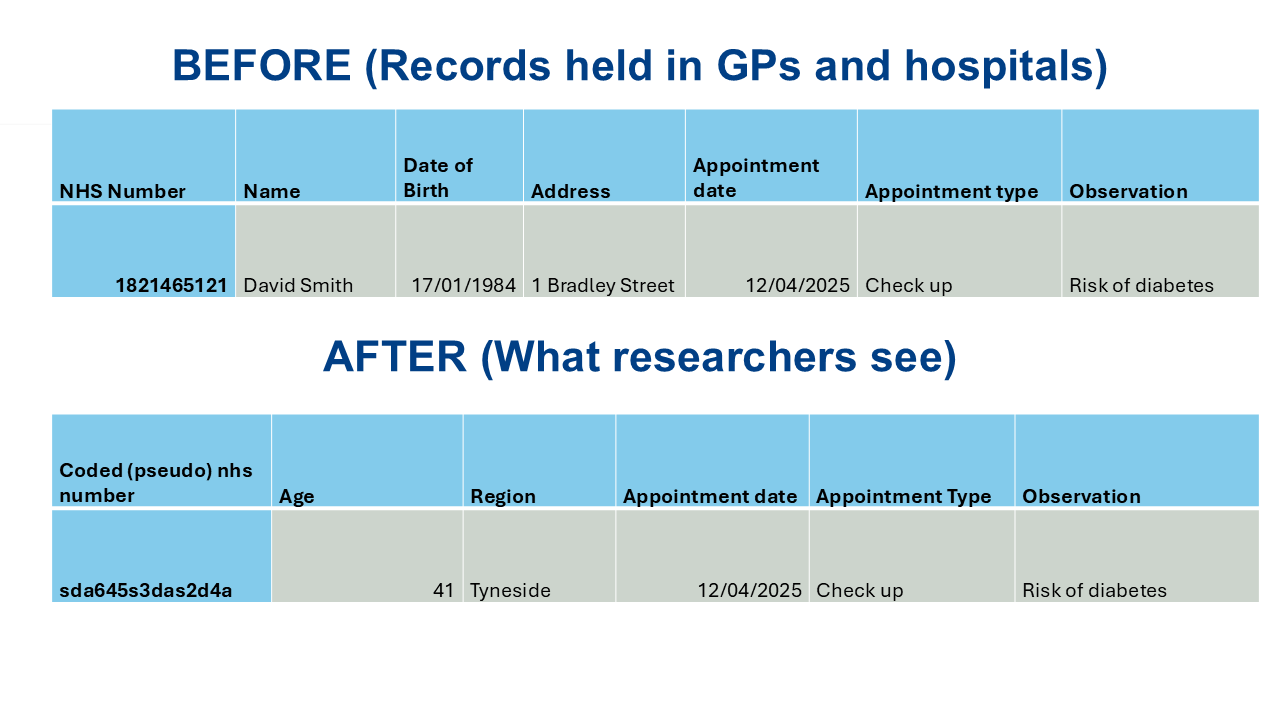
What does my patient record look like and what will the researcher see?

We remove key pieces of information such as your name, date of birth and address. Your NHS number is scrambled with a code. Your age, or age group may be visible but not your date of birth. Also your address and postcode are removed and replaced with an area code.
This is so you can't be identified.
In this example, you can see what your patient record looks like before and after its been processed. Anything which can identify you is removed.
Researchers and planners can't see your whole record. Just the pieces of information that are useful to them.
What is changing?

Researchers contact GP practices or hospitals to ask for information from health and care records. This might include information like what medicine people take. Access to this information helps them carry out research.

Researchers have to ask lots of different places for information which can be hard. It also makes it hard to link information from different places.

This means researchers don’t always have the best information to work with. This way of sharing will be stopped in the future. Instead, researchers have to come to a Secure Data Environment. This will give them better, linked information which they can’t take away or use it again.

SDE podcasts

Listen to our Secure Data Environment podcast series. Find out more about how health and care data can be used safely for research and planning, and the role of public members in our decision making.

Health and care information will be stored in a space known as a Secure Data Environment. Only approved individuals will have access to the data and only for a specific project.

Health and care records are well protected under the law*. Health and care staff and researchers must have very specific permissions to use personal health information and any organisation that holds this, like your GP practice, is the legal controller for that data.

The controller has responsibility for making sure any information they hold about people is kept safe, secure and private.

*The Secretary of State for Health and Social Care (for non research purposes) and the Health Research Authority (for research purposes) has supported the application from the North East and North Cumbria Secure Data Environment following advice from the Confidentiality Advisory Group (CAG) under section 251 of the NHS Act 2006.

Anyone who wants to access your health and care information for research or planning needs to send an application covering why they want to access it. 

They must:

  • Work in a trusted organisation such as the NHS, a university, a charity or pharmaceutical company
  • Have training in how to use the Secure Data Environment – and how to keep patient information safe

The project must:

  • Meet legal and ethical standards 
  • Be checked by experts to make sure that only the right people and projects can have access to the Secure Data Environment

When health and care information is made available for research, information which could identify you is removed. 

NHS staff who are not part of your medical care team remove information like your name, NHS number and address from your record. This is so we can remove or hide your identity, but still link your records together. Your consent for this is not needed.

Health and care information will only be made available to approved researchers and NHS planners for specific projects.

New medicines

Biomedical companies and universities can develop new treatments based on the information from lots of people with similar conditions. 

Improved NHS services

Public health experts can better plan healthcare services, so the right services are there for local people’s needs.  

Better outcomes

Researchers can analyse patient data to see which treatments work best, leading to even better care.  

Find out more

You can also find out more about how patient records benefit research and planning on the NHS England Powered by Data website 

There are 10 Secure Data Environments across England covering different regions. Together, they create the NHS Secure Data Environment Network. Sharing information across NHS Secure Data Environment Network helps researchers and analysts do larger, more complex projects. Information might also be shared with similar databases in Scotland, Wales and Northern Ireland.

All projects go through strict checks to make sure they are:

  • Safe
  • Secure
  • In the public interest

Using information from more than one region in the UK helps researchers and analysts answer questions that one area alone can’t. It also means they can compare different areas of the country. This is very helpful when studying rare diseases or for large public health projects.

Working across the network also helps avoid doing the same research more than once. This makes better use of time and money.

We only share information with projects that have been approved by a Data Access Committee (DAC).

Every Secure Data Environment has a Data Access Committee. This includes staff such as doctors and data protection specialists, as well as members of the public. They check that every project is safe and will benefit patients.

Information that could directly identify you, like your name, or NHS Number, is removed before it is used in a Secure Data Environment.

In some projects, we may need to move information between Secure Data Environments. If this happens, it is moved securely using protected systems. For other projects, the information can stay where it is. Each project is carefully checked to decide the best way.

If you have already opted out, your information will not be included. We check for opt-outs when information is added to a Secure Data Environment. We check again before it is available to projects.

We are open about how information is used. We publish a list of all approved projects who have access to our Secure Data Environment. This includes:

  • What is their research
  • Who is doing the research
  • Who they work for
  • Who is paying for it
  • What information they can access

The list is available on the North East and North Cumbria ICB website. It includes projects working with other Secure Data Environments.

One project which could use information from the North East and North Cumbria in the future is the national Prostate Cancer Research (PCR). The project aims to help researchers learn more about the disease and make patient care better.

The researchers are aiming to do this by looking at patients from around the country by using information from different Secure Data Environments. The North West Secure Data Environment is leading this work.

By learning more about what treatments work best the NHS can give patients better prostate cancer care.  In the future, we can study different diseases that affect people across England by following this project’s example.

Watch how the Secure Data Environment helps improve patient care while keeping your information safe and secure.

Any questions about the Secure Data Environment?

Contact us on email or call us on 0191 916 9353 (available Monday to Friday, 9am to 5pm).